Size constancy is the term for our tendency to see distant objects as larger than they are. So the far end of a shape with parallel sides looks wider than the near end. (See the earlier post on The Wonky Window). It seems to be such a basic feature of vision that it can give rise to amazing effects. In the photo, first note note that the “sculpture” is impossible! All four blocks are receding from us, so they could only connect up in real space as a bendy snake. Instead they join up in an impossible, ever-receding, endless loop. (See the earlier post on M.C.Escher’s Waterfall for how that kind of impossible figure works). Here the endless loop leads to a paradox, thanks to size constancy. The distant end of each block seems wider than the near end, and yet at the same time seems to be exactly the same size as the apparently smaller, near end of the next block. Measure the sides of the blocks and you’ll find them parallel. It’s one of many demonstrations that perceptual space is not always geometrically consistent, (or it can be non-Euclidean, as the specialists put it).
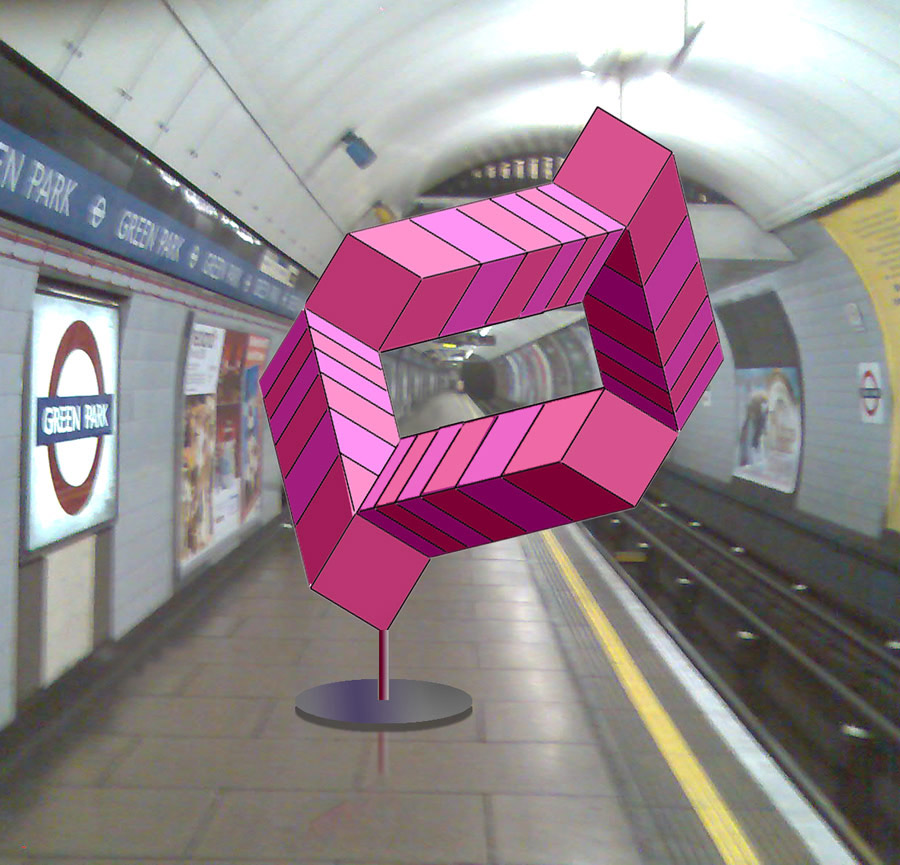
I located my impossible sculpture in a deeply receding space because that makes the effect just a bit stronger.
Update January 2010: How could I have overlooked this? The stripes I’ve added to these blocks will be enhancing the effect of divergence by adding the chevron illusion to the size-constancy effect. The chevron illusion was first reported 500 years ago, by French writer Montaigne, as related in Jaques Ninio’s book on illusions, page 15. The chevron effect is a special case of the illusion later re-discovered a bit over a century ago as the Zollner illusion. Some specialists would say both effects depend on the brain’s attempts to make sense of figures as shapes in space. I suspect that’s true of the size-constancy effect, but that the chevron effect is 2D, pattern driven. That seems supported by the observation that whilst in the picture above the chevron and size-constancy effects are acting in consort, they can also oppose one another, reducing the effect of divergence.
Read on for more on size-constancy.
Size constancy is such a powerful effect. Any parallel lines will appear (at least for some observers) to diverge with distance, if set a bit obliquely within the converging lines of a perspective (like for example the edges of the platform above). But now look at the stereo pair of pictures below. If you don’t yet have the knack of viewing stereo picture pairs without a viewer, first try this tutorial. If that doesn’t help, try some similar sites, by searching on “Viewing 3d pictures”.
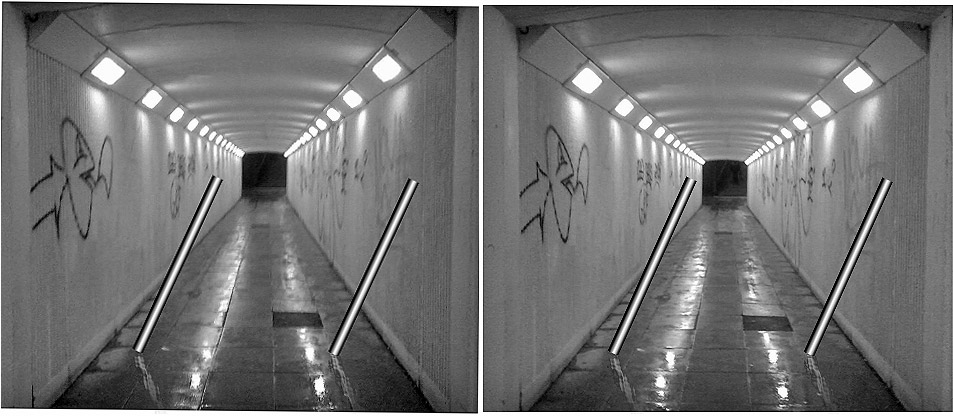
In our picture pair, the bars are strictly parallel. The paradoxical point is that even when viewed in 3D as not receding into the underpass, but as lying in the vertical picture plane, the bars still, even in 3D, show size-constancy divergence. The effect is apparently embedded so early in the brain’s attempt to make sense of visual scenes that it cannot be over-ridden by knowledge.
That ties in with an astonishing experiment published in 2006. Researchers asked their experimental observers to look at a size-constancy effect whilst their brains were imaged with the technique fMRI. The image was done with extremely salient, flashing lines. Amazingly, the researchers could reveal the trace of the flashing lines in the fMRI image of the back of the observers’ brains. The key point was that the image in the brain was not of the objective shape of the stimulus, but of the shape adapted by the size-constancy effect. And yet, this adapted image was not formed on a surface in the brain at the very end of the long and complex visual pathways. It appeared rather early in the process (area V1), before, as far as is understood, it could be affected by higher knowledge about the scene. As the 3D image above also shows, we seem to be hard-wired for size constancy!
Well, maybe. But here’s an UPDATE on May 22nd 2011! Judging by responses to similar pictures since the original posting, there is considerable variation in the extent to which viewers see any divergence from parallelism in the rods in the last picture pair, above. Also, when any effect is seen, it seems to depend critically on the placing of the bars, and just how they intersect with the receding edges between floor and walls behind them. That might suggest that the divergence that some observers see may not be a size-constancy, distance processing effect at all, but just a 2d interaction – an opponent effect – between the orientation of the bars, and of the edges in the 2d image with which they intersect. But I don’t think it’s that simple: if I remove all the 3D context, just leaving the converging lines that the bars overlay, the divergence that I see strongly in the pictures above vanishes. I think there’s a size-constancy effect at work, for some observers, but with mysteries that I for one have yet to puzzle out.