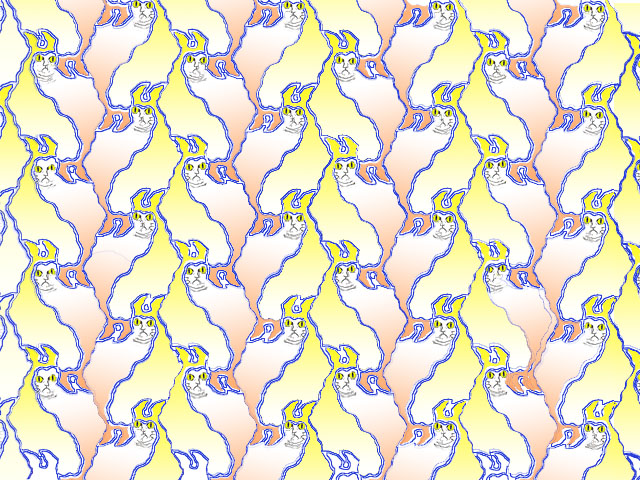
Just about our first post was a tessellation tutorial. It was quite comprehensive, but a bit heavy going. I’ve been wanting to post an animated demo, because I reckon that seeing that first would make the tutorial much easier to follow. So the animation is below, but first, a reminder of the basics:
A tessellation is a pattern like the one above. The cells of the pattern fit together like jig-saw pieces, with no gaps and no overlaps. You can’t make a pattern like that out of just any old shape. It only works with shapes whose edges can be snipped into pairs of segments with special properties. The two segments in each pair must be indentical, except that they may be either reflections of one another, or rotated in relation to one another, like the hands of an old-fashioned clock. Confused already? Just watch this animation, showing the evolution of the pattern above, and you’ll see how it all works.
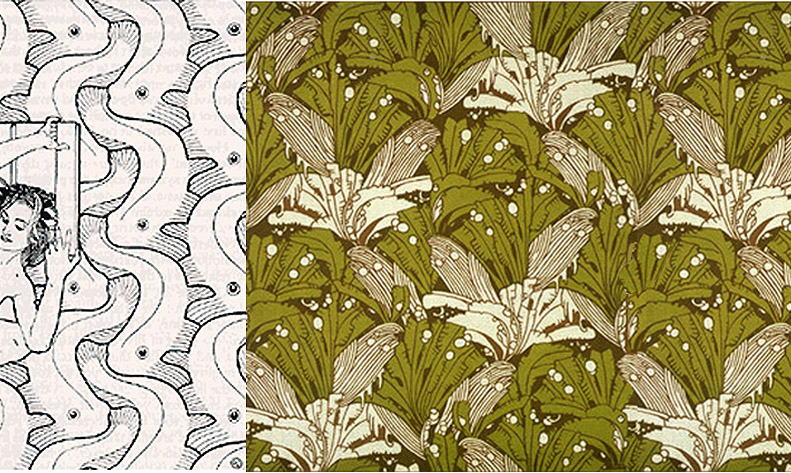
You probably know the tiling patterns of M.C.Escher. But how about Koloman Moser? Here are a couple of his designs.
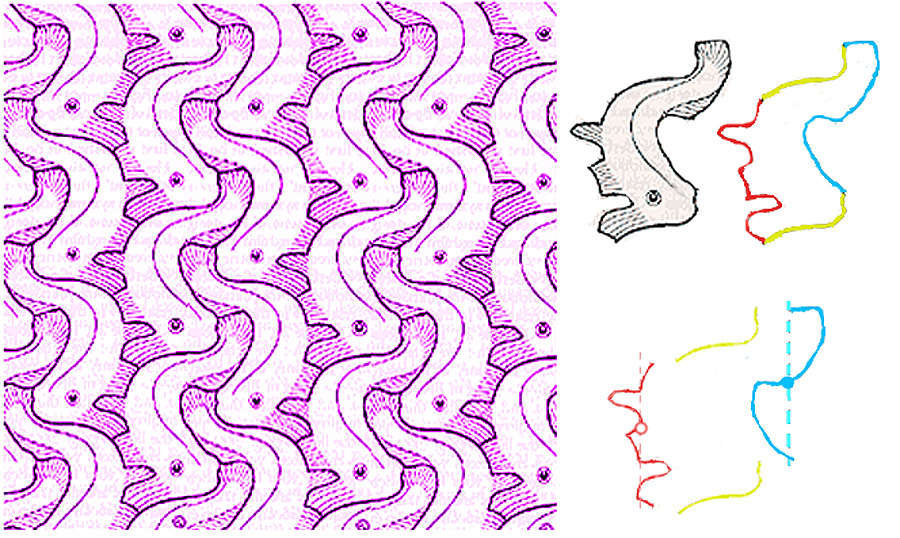
Moser was working in Vienna, Austria, a hundred years ago. (He died in 1918). I don’t know where he would have learned to do tessellating designs, that is, designs with motifs that repeat the way jigsaw puzzle pieces fit together, with no gaps or overlaps. If you have checked out our tessellation tutorial, you’ll know that the secret of these designs is that the edge of each “tile” of the pattern must be able to be snipped into pairs of identical line segments. Here’s how it works with Moser’s fish design.
To the right you can see that the fish outline can be divided into three pairs of segments, a yellow pair, a red pair and a blue pair. In the yellow pair, the top line is just repeated lower down to make the pair, in a move called a translation. The red and blue pairs are a bit more complicated. In each pair, the lower line segment is a mirror reflection of the upper segment, but shifted downwards. That kind of shifted reflection is called a glide reflection. It’s a fact that any motif whose edges can be snipped into one pair of segments that repeat by translation, connected as here to two parallel pairs whose edges repeat by glide reflection, will tessellate perfectly. And that’s just one of 28 recipes for motifs that tessellate.
The second Moser design is based on exactly the same recipe, but it’s more complicated. In fact, it’s fiendish …..
The Dutch tessellation whizz M.C.Escher was fascinated by transformations from one tessellation to another, for example in his series of prints Metamorphosis. I’m sure he would have explored animated versions if it had been practical in the 1940′s. So I’ve borrowed a couple of his motifs and animated them. I showed an animated transformation in an earlier post, but that was between two designs that shared the same kind of symmetry. (See the earlier tessellation tutorial for how these tessellations work. If you like technical detail, my earlier animation was of two motifs based on Heesch tessellation no. 11). Sticking to just that one kind of tessellation meant that the corners of each cell of the design had to remain stationary, and only the edges of the cells transformed. This new transformation is a bit different, because it’s not just a transformation from one motif to another, but between two different kinds of symmetry pattern – Heesch nos 17 and 18 in the tutorial – and the corners of the cells of the pattern are not fixed.
In the earlier transforming animation, the design transformed in space, across the image, as well as transforming in time. If I’ve got it right, (I’m not 100% sure about this), that kind of time plus space transformation is not possible in an animation if the corners of the cells of the tessellation change position, as in my new tessellation above. So in this new animation, there’s no change from cell to cell across the design, and all the cells transform together.
I’m fascinated by the artistic possibilities of these kinds of animation, and one aspect of it is to do with what you might call the dance rhythms of the animation. Here’s a variation on the new animation, speeded up and with an added wave that gives a quite different kind of pulse to the design.
These animations are bit monochrome for the moment – colour is on the way, but I’m on a steep learning curve with file sizes, compression etc.
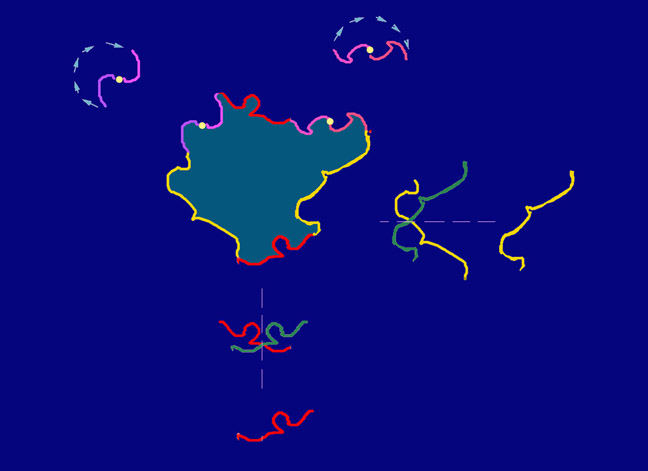
A tessellation is a pattern made up of elements that repeat with no gaps and no overlaps. The elements may be abstract shapes, or may be recognisable objects or creatures, like the ones in the tessellations of M.C.Escher. When I begun playing around with tessellations, I thought understanding the procedures needed to make patterns that tessellate would be the hard part. I thought it would be fairly easy to find creatures in whatever shapes I ended up with. Not so. The procedures aren’t so hard. But fitting creatures into them I found really difficult. Here’s one of my first attempts. I started with one of the most complicated recipes for a tessellation.
For the details of the procedures, which give shapes that tessellate, see my tessellation tutorial. Essentially, the boundary of every shape that will tessellate is made up of pairs of lines. Within each pair, an identical line repeats, either by rotation, reflection, or just by shifting over. In the example above, there are four pairs of lines, two of them with rotations and two with reflections.
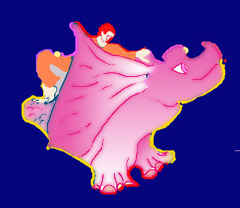
But what creature could I discover in this shape? Here’s what I came up with, a cross between an elephant and a rhino, with a little man on its back.
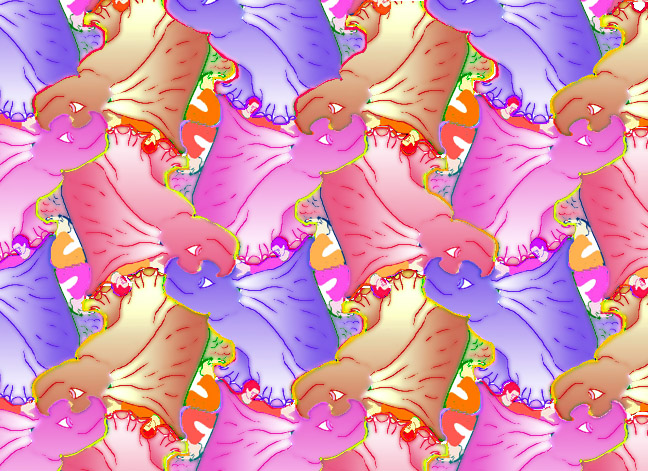
And it does tessellate! It gives a pattern in which the elenoceros repeats four times, right way up facing both ways, and then upside down facing both ways.
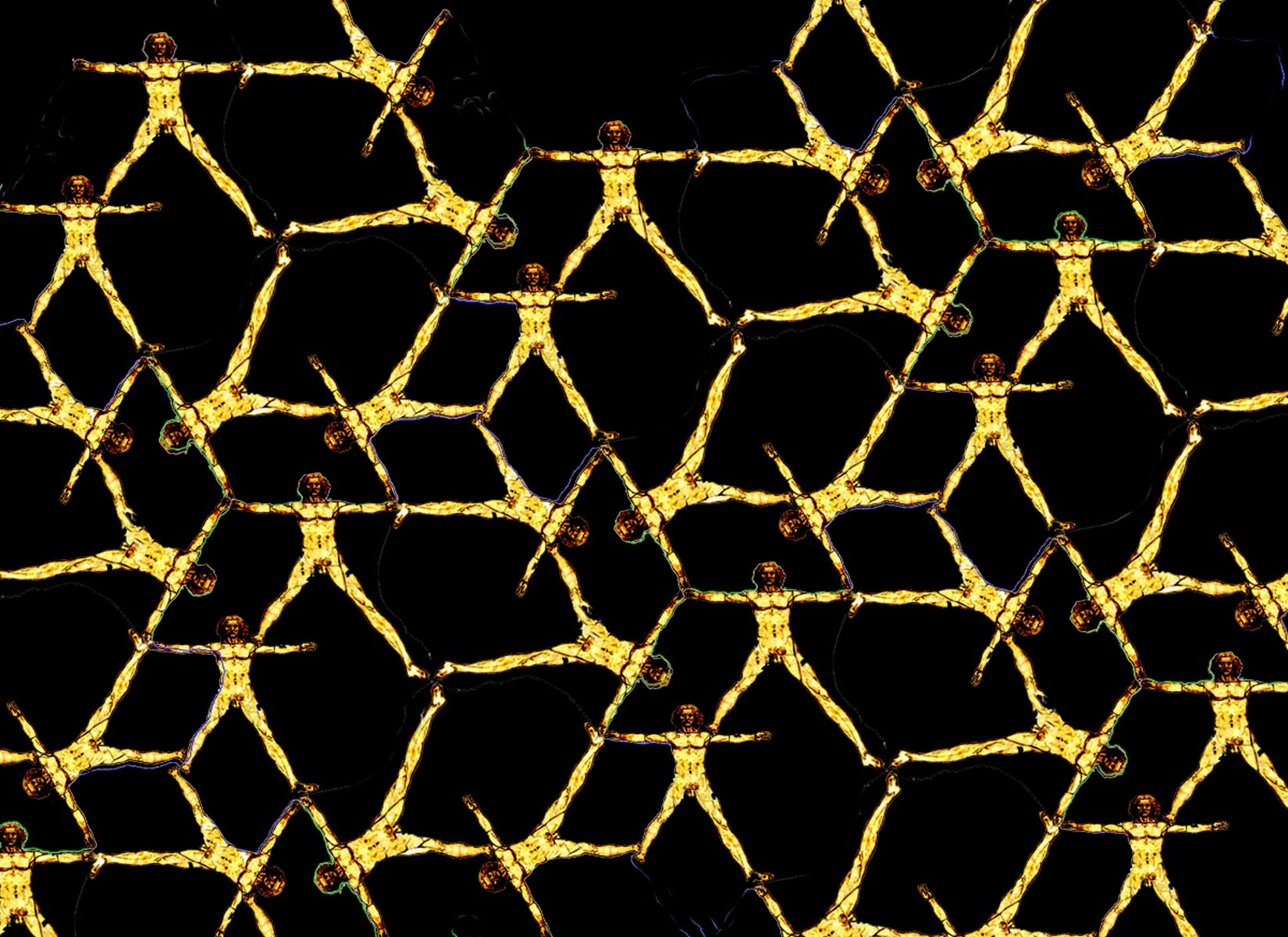
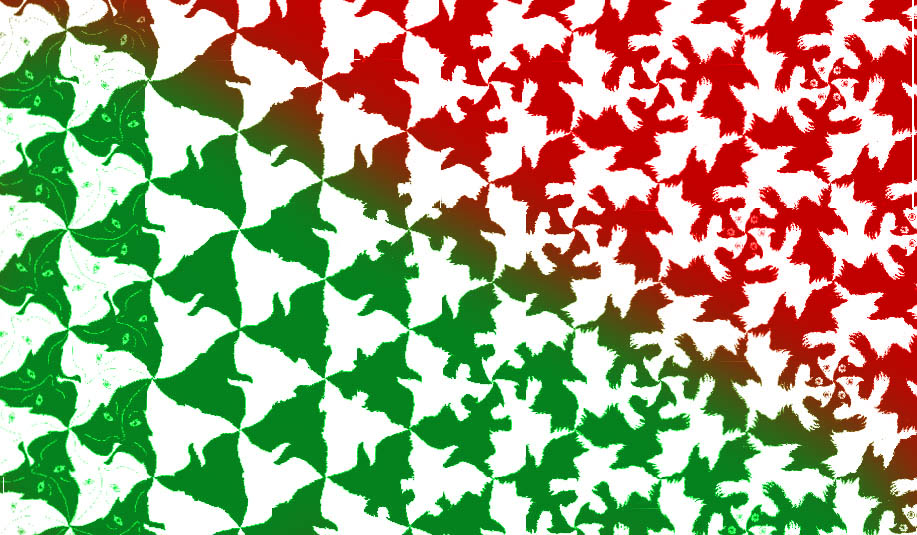
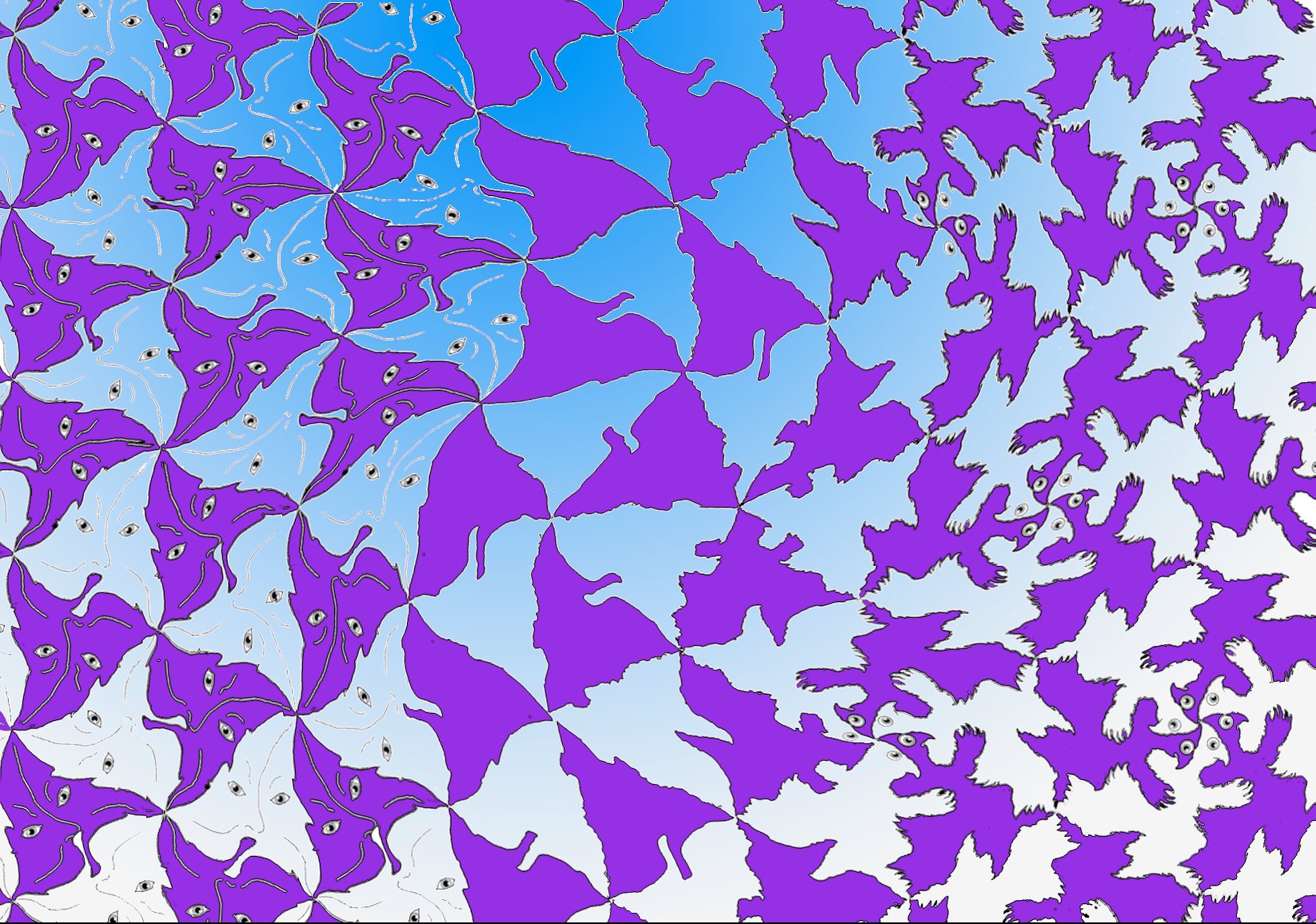
I love tessellations. Here’s quite a complicated example, with a transformation running across it, and an added graphic twist.
Want to try your own tessellations? There are software short-cuts you can use but to really get the hang of them, do them by hand, with a graphics package on a computer. (I use the graphics facility in a full version of Photoshop, but any capable graphics package should do the business. You will need to be fairly handy with it before you start doing tessellations, however). Or you can also really do them by hand, with tracing paper and pencil.
Any regular pattern consists of identical areas, which repeat without overlaps or gaps. An obvious example would be tiles on a wall. However tiles are usually geometric shapes – rectangles or squares as a rule, though triangles or hexagons would be possible too. In a tessellation, the cells can have wiggly edges, but still fit together like jig-saw pieces.
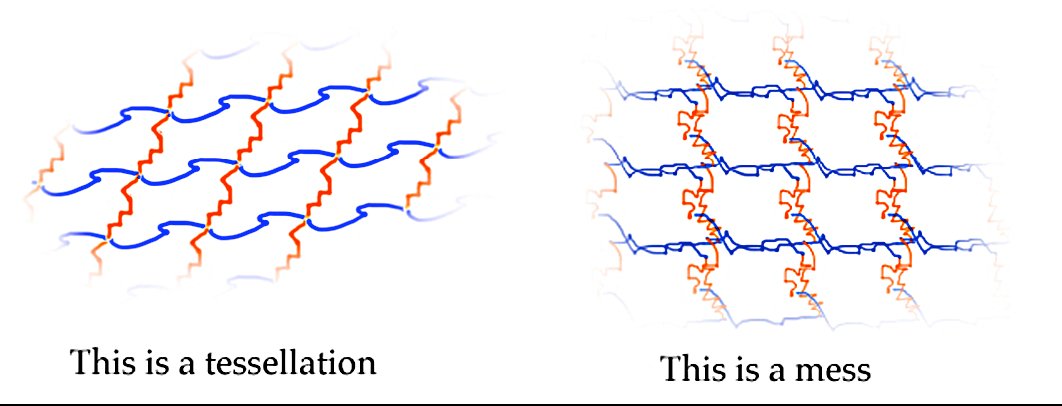
If you try to make a pattern like that out of any old shape, you will either end up with gaps or overlaps:
To make cells that tessellate, you have to follow a recipe. There are a whole set of recipes, but to get an idea of how they work, take a look at just one.